Academics
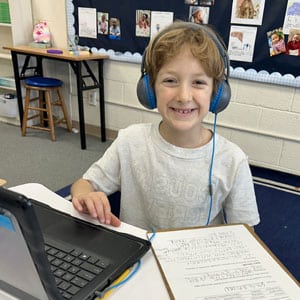
By Julie Schlossinger, Associate Head of School As parents and educators, we are navigating a moment unlike any other in history. The pace of technological change and the use of AI is accelerating, leaving many families wondering how to support healthy development while embracing the opportunities these tools bring. At Renbrook School, we believe that…
Read More ...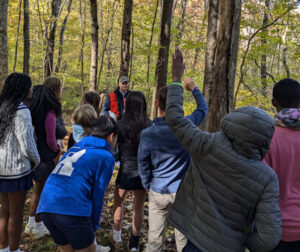
Renbrook School’s Living Classroom on Avon Mountain An interview with Lincoln Vaughan ’91, Upper School Science Department Chair and alumnus Bringing Learning to Life in the Forest High atop Avon Mountain, Renbrook School’s 75-acre campus is more than a scenic backdrop—it’s an extension of the classroom. Guided by a spirit of stewardship and scientific inquiry,…
Read More ...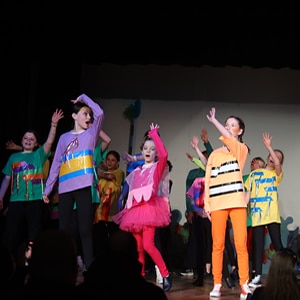
This past weekend, the Renbrook community had the pleasure of experiencing several incredible performances of Finding Nemo, Jr., presented by our talented Upper School students. As we watched these students shine on stage—excelling in singing, dancing, acting, stage changes, and behind-the-scenes work—it was impossible not to recognize the transformative power that theatre has on our…
Read More ...
While rigor is a term used often in education, its meaning varies greatly depending on who is using it. For those of us within the college preparatory, independent school world, one frequently reads or hears about programs, teachers, and/or curricula that are either rigorous or lacking thereof.
Read More ...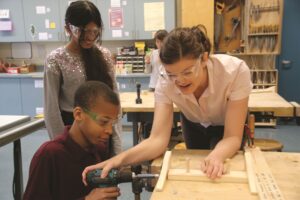
Katie Jackson is in her second year of teaching at Renbrook. We interviewed her to learn more about her passion for learning and teaching.
Read More ...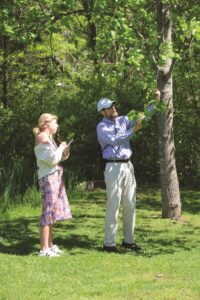
“SCIENCE: Because figuring things out is better than making stuff up.” This quotation from Neil Degrasse Tyson, is emblazoned on one of Howard Wright’s favorite T-shirts, and it sums up the core of scientific thinking. Evidence, tested and tried, is the basis of knowledge, not assumptions, hunches, or opinions. Skepticism, readiness to reconsider, and openness to new evidence are essential to scientific thinking, and our Upper School students live it every day.
Read More ...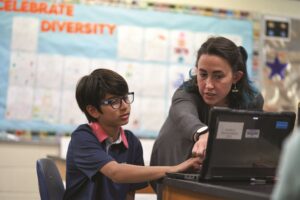
Olivia Goodrich, Upper School STEAM teacher, is all about inquiry-based learning. The process goes like this: start with a question; observe; gather data; generate more questions to guide further observation; continually revisit the same phenomenon to dig deeper; test your previous conclusions.
Read More ...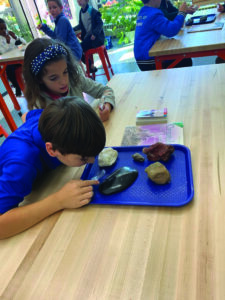
We asked Jessica Wawzyniecki, Lower School STEAM teacher, “How does scientific thinking develop over the course of Grades One through Four?”
Read More ...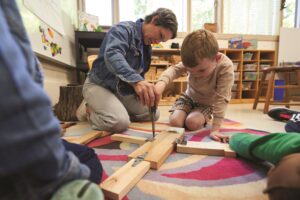
In the Beginning School, children are naturalists. Our 75-acre campus beckons them to explore the outdoors and the creatures, plants, and rocks they find there. They are taught to stop, pause, and look more closely. Our youngest students are not bound by a curriculum; they follow their own discoveries and observations. Their teachers build on the children’s own curiosity to lead them into the process of formal inquiry.
Read More ...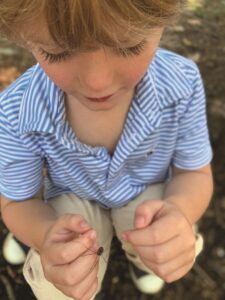
For the next several weeks, follow us as we explore the notion of scientific thinking. What do we really mean by scientific thinking, and how does it inform our teaching and learning at Renbrook School?
Read More ...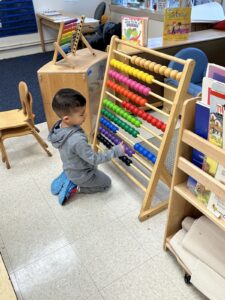
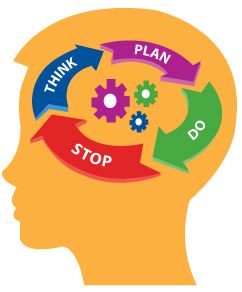


As adults, we tend to overlook the complexity of the ability to make meaning from something we read because we have been doing it for a long time and because it happens automatically and instantaneously for so many of us. For children, though, especially during the elementary school years, there is so much involved in processing print.
Read More ...

We recently had the pleasure of hearing from a panel of therapists with whom we work closely to support the language and social and emotional development of our students here at Renbrook. We partner with these professionals to develop a child’s toolbox of strategies for success and to educate our teachers to incorporate these strategies into the classroom. We know that children thrive when we function as a team.
Read More ...


Enjoy Alana’s paper here.